
Assessing the actual value of a house is not limited to multiplying a surface area by a price per square meter. Several criteria overlap, some visible during a visit, others detectable only by recent analytical tools. Understanding their respective weight in a real estate appraisal helps avoid discrepancies between the listed price and the actual selling price.
Predictive Models and Satellite Imaging: What AI Changes in Real Estate Valuation
Traditional estimation methods rely on comparisons with recent sales in the same area. This approach works well when the market is stable and the properties are comparable. It reaches its limits in the face of local risks not visible during a visit: shrink-swell of clays, areas of recurrent flooding, urban heat islands.
AI models now leverage satellite imaging to integrate these climatic parameters into the evaluation. By cross-referencing topographical data, historical weather data, and soil mapping, these algorithms identify vulnerabilities that an on-site expert cannot measure with the naked eye.

The concrete result: two identical houses on the same street can receive different estimates if one is located on clay soil with high shrinkage. Traditional tools, based solely on past transactions, do not capture this discrepancy. To delve deeper into the parameters that weigh on a property’s value, Immo et Habitat’s advice details the criteria to consider before any sale.
Energy Performance Diagnosis and General Condition: Real Impact on a House’s Selling Price
The energy performance diagnosis directly influences negotiations. A property rated F or G suffers a depreciation compared to an equivalent property rated C or D. The extent of this depreciation varies according to local markets, but the trend is consistent: a poor energy performance diagnosis prolongs the selling time and pushes the price down.
| Criterion | Impact on Value | Visible During a Visit |
|---|---|---|
| Energy Performance Diagnosis (energy class) | Direct depreciation on the price per m² | Yes (mandatory display) |
| Condition of the roof and facade | Cost of repairs deducted from the price | Partially |
| Shrink-swell risk of clays | Latent depreciation, often ignored | No |
| Proximity to transport and shops | Premium depending on the area | Yes |
| Accessibility for people with reduced mobility | Extended selling time if absent | Yes |
The general condition of the property weighs heavily, but not in the same way depending on the aspects. A kitchen needing renovation represents a predictable cost that the buyer easily incorporates. In contrast, structural issues (cracks, rising damp, weakened framework) create uncertainty about the repair costs, leading buyers to negotiate more aggressively.
Accessibility and PMR Standards: An Underestimated Criterion
According to the “Real Estate Market 2026” study by FNAIM (February 2026), houses without adaptation to PMR standards have a selling time extended by 30% compared to accessible properties. The demand for adapted housing is increasing, driven by the aging population and inclusion policies. Ignoring this criterion in the estimation amounts to overlooking a growing segment of potential buyers.
Online Estimation or On-Site Expertise: Comparative Reliability
Online estimation tools have multiplied. They rely on transaction databases (DVF, notarial data) and provide a price range in just a few clicks. Their strength: speed and access to a volume of data that no one can process manually.
Their weakness: they do not capture the actual condition of the property or the micro-variations of a neighborhood. A tastefully renovated house and a dilapidated house on the same street will receive almost identical online estimates. The algorithm sees the address and the size, not the quality of insulation or the orientation of the living room.
- Online estimation provides a useful ballpark figure as a starting point, but it does not replace a visit.
- The expertise of a real estate agent or appraiser incorporates qualitative elements: brightness, layout, noise nuisances, potential for extension.
- Advanced AI models (satellite imaging, climatic data) are beginning to bridge the gap between these two approaches by adding layers of invisible information on the ground.
The Local Real Estate Market Remains Determinant
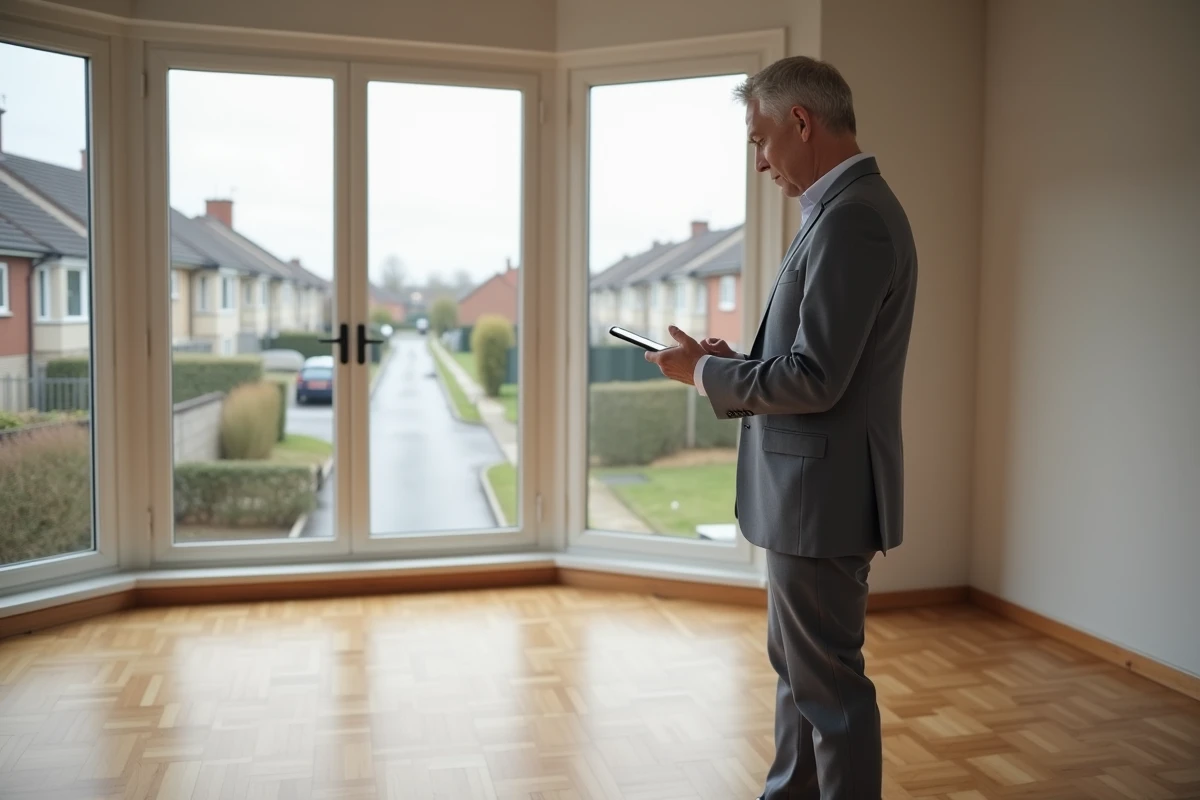
No tool, no matter how sophisticated, works without market context. The price per square meter varies according to the municipality, the neighborhood, sometimes even the street. Recent transactions within a limited perimeter constitute the most reliable reference for calibrating an estimate.
A common pitfall: relying on an average municipal price when the property is located in a micro-sector very different from the average. A neighborhood close to a train station or a reputable school group drives prices up. Conversely, a plot on the edge of a business zone sees its value capped, even if the municipality shows an overall upward trend.
Market Value and Selling Price: Why the Gap Persists
Market value is a theoretical estimate. The selling price also depends on the balance of power between the seller and the buyer, the time on the market, and the quality of the property’s presentation (photos, home staging, listing).
An overvalued property stays on the market longer. This stagnation sends a negative signal to buyers, who interpret the duration of the listing as an indication of hidden problems or excessive pricing. The result: a more aggressive negotiation and, often, a final price lower than what a correct initial estimate would have allowed.
The most useful estimate is not the highest, but the one that reflects the price the local market is willing to pay. Cross-referencing an online tool, AI-based climate analysis, and the opinion of an on-site professional remains the most reliable combination to reduce the gap between estimated value and the price signed at the notary.