
The French political news regularly produces sequences that comedians would not have dared to write. Between a government launching its own anti-disinformation unit called “Bercy Décode,” American hosts threatened with dismissal for a joke about a president, and generative AI tools capable of producing political sketches en masse, the line between satire and political reality has never been so porous.
Spring 2026 offers a concentration of these tensions where laughter, institutional communication, and technology collide.
AI-Generated Sketches: Political Satire Facing Automation
Grok, ChatGPT, and other generative AI tools now allow anyone to produce a political sketch in a matter of seconds. All it takes is a prompt – “write a parody of a presidential speech on pension reform” – to obtain a structured text, with calibrated punchlines and a tone that mimics the codes of television satire.
The result is often technically correct. The references are up-to-date, the rhythm works, the puns hold up. However, AI reproduces comedic mechanics without understanding the emotional context that gives a political joke its weight.
A comedian like Jonathan Lambert, interviewed by Public Sénat in May 2026, summarizes the era with a phrase: “Dictatorship is a one-man show that went wrong.” This type of shortcut, rooted in a personal reading of power, remains beyond the reach of a language model.
To follow Sarkostique’s news, which precisely compiles those moments when politics tips into the absurd, a human perspective is needed to prioritize what is funny and what is serious, sometimes in the same sentence.

The question raised by this wave of automated tools is not about the disappearance of comedians. It concerns dilution. When thousands of parodies circulate daily on TikTok or X, generated en masse by anonymous accounts, the public loses the ability to distinguish a genuine satirical stance from disposable content. The human comedian finds themselves drowned in a background noise they did not produce.
Political Reactions to Satirical Humor: France vs. the United States
The way political leaders react to satire varies significantly from one side of the Atlantic to the other. In France, jokes about leaders provoke shrugs, sometimes an annoyed tweet. The tradition of Guignols, Le Canard enchaîné, and Canal+ impersonators has established a de facto tolerance.
In the United States, the climate is different. Since March 2026, Donald and Melania Trump have publicly called for the firing of host Jimmy Kimmel after a joke deemed “disgraceful.” Kimmel’s detractors accuse him of inciting political violence. This escalation illustrates a polarization where humor is no longer seen as an outlet but as a partisan weapon.
The available data does not allow us to conclude that France is immune to this type of tension. The launch of “Bercy Décode” by the French government in May 2026, presented as a tool against disinformation, shows that the line between official communication and narrative control is becoming blurred. When a ministry decides to “decode” what circulates online, satire risks ending up in the same basket as disinformation.
Comedians and Satirical Culture in France: What 2026 Reveals
The landscape of French political humor is undergoing a period of reconfiguration. Several trends intersect:
- The rise of female comedians, who are renewing the angles of attack on politics. Festivals and performance platforms now dedicate programming to them, a sign of an expanding audience.
- The success of short formats on social media, where clips of a few seconds (a slip of the tongue in the Assembly, an unexpected reply in committee) circulate faster than any written sketch. Channels like PoliToc compile these moments and accumulate hundreds of thousands of views.
- The return of stage comedians to openly engage with political issues. Jonathan Lambert, in his interview with Public Sénat, claims a burlesque reading of the era without seeking to please one side. This stance contrasts with the caution of previous years, where many avoided political topics for fear of backlash.
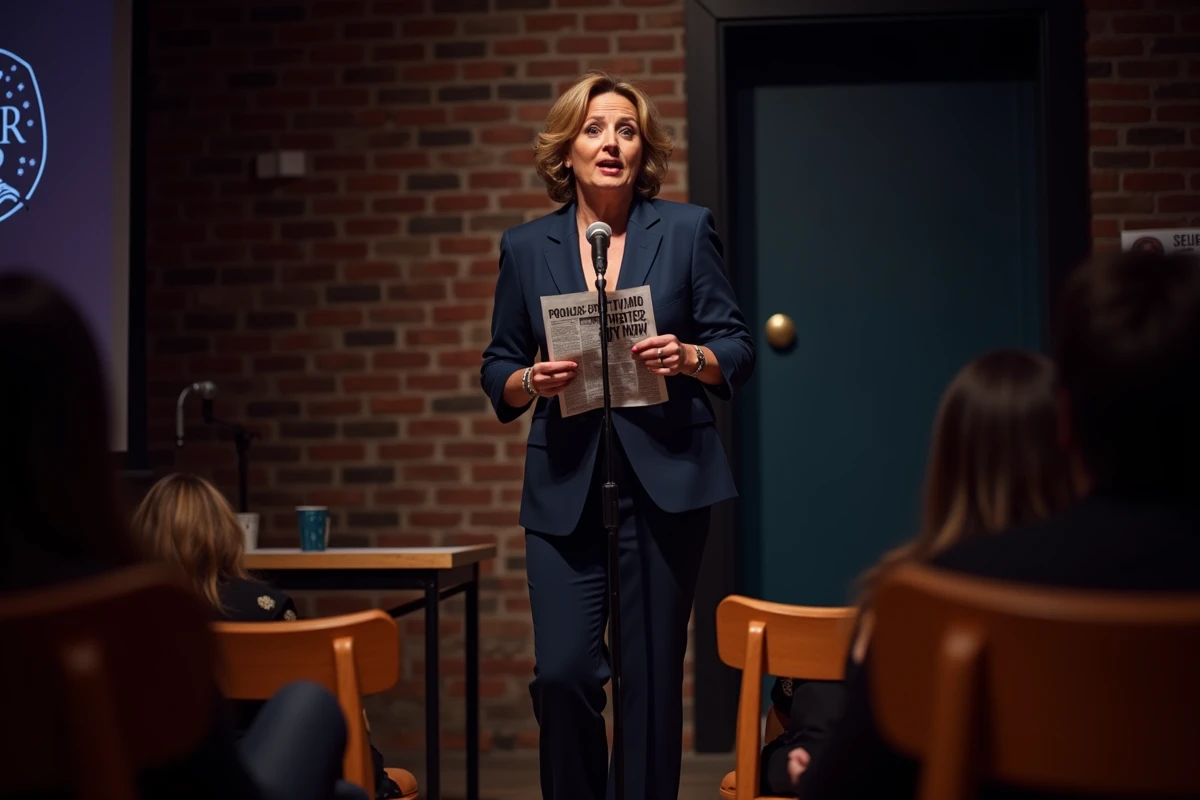
This renewal does not come without friction. The clash culture, imported from television studios and amplified by algorithms, pushes comedians to seek the viral phrase rather than long construction. The five-minute sketch is losing ground to the fifteen-second quip.
Generative AI and Authenticity: Where to Draw the Line
The fundamental question is not whether AI can be funny. It can be, at times. The problem lies elsewhere: in the relationship between the comedian and their audience. A political sketch draws its strength from the fact that a human being takes a risk in saying it. This risk (social, professional, sometimes legal) gives laughter its political dimension.
When a tool automatically generates a parody, no one takes a risk. The satirical content then loses its function as a counter-power to become pure entertainment, interchangeable and without consequence. Politicians who react violently to a joke from Jimmy Kimmel will never react the same way to a text generated by a machine. The target disappears.
Field feedback diverges on this point. Some creators use AI as a writing tool, to test angles or speed up content production. Others categorically refuse, believing that the authenticity of a human perspective remains the only bulwark against the trivialization of political humor.
Political humor in 2026 is played out on multiple simultaneous fronts: the stage, social networks, studios, and now automatic generators. The real dividing line does not lie between what is funny and what is not, but between what engages responsibility and what does not.