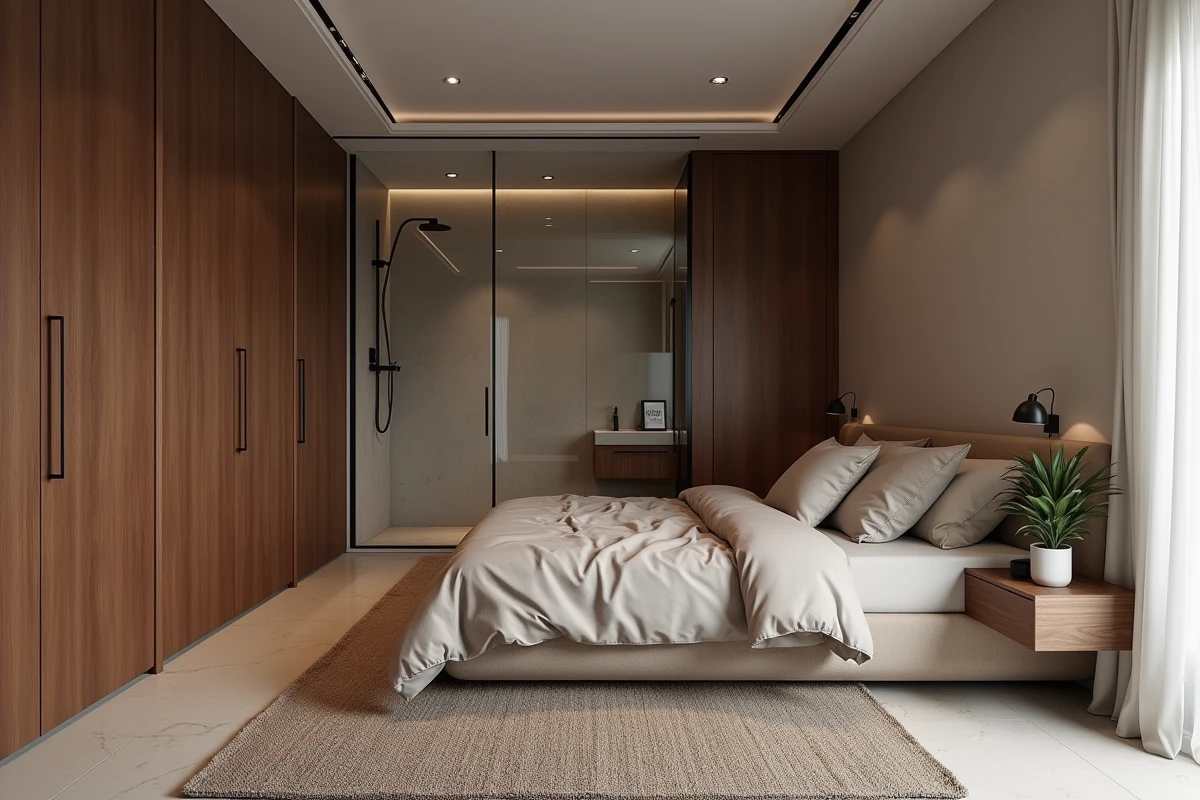
With a surface area of fifteen square meters, the temptation is strong to replicate the plans seen in magazines. The result often disappoints: a shower cramped against the bed, a passageway that is too narrow, a faucet noise that wakes you up at five in the morning. Successfully creating a master suite of 15m2 with a bathroom requires solving three problems simultaneously: the distribution of square meters, acoustics, and ventilation of the wet area.
Sound insulation in a master suite with integrated bathroom
Have you ever been woken up by the sound of a toilet flush through a wall that is too thin? In a compact master suite, the problem is amplified: the shower or sink is sometimes less than two meters from the head of the bed.
For several years now, the demand for acoustic insulation has become a priority for individuals hiring an interior designer. According to a survey by the National Union for Home Development (UNAM), acoustics is among the top three requests for master suite projects.
In practical terms, this involves a double soundproof wall between the sleeping area and the bathroom, better-sealed doors, and so-called silent plumbing fixtures (thermostatic mixers with ceramic cartridges, for example). These technical choices cost a bit more than a simple standard drywall partition, but they radically change daily comfort.
To successfully design a 15m2 master suite with a bathroom that remains pleasant to live in, acoustics should be at the top of your specifications, even before choosing tiles or plumbing fixtures.
Distribution of square meters: compact bathroom versus livable bedroom
Fifteen square meters is a fixed envelope. Every centimeter allocated to the bathroom is taken away from the sleeping area. The central question is not “how to fit in a bathtub,” but “what is the minimum viable for the wet area.”
The practical threshold for the bathroom
Interior designers note that below four to four and a half square meters actually dedicated to the bathroom (excluding circulation), daily life becomes complicated. Lack of storage, inability to pass each other, humidity too close to the bed: an undersized bathroom degrades the entire suite.
With a bathroom calibrated around this minimum surface area, there are about ten square meters left for the sleeping area. This is sufficient for a bed of 140 or 160 cm, two nightstands, and a comfortable passage on each side.
Choosing between shower and bathtub
In a suite of this size, the walk-in shower remains the most coherent choice. It takes up less floor space than a bathtub, facilitates waterproofing, and integrates better visually into an open or semi-open space. A freestanding bathtub, as attractive as it may look in photos, consumes almost the entire spatial budget of the bathroom.
If you are absolutely set on having a bath, opt for a compact corner model, but check beforehand that circulation around the bed remains fluid once the layout is drawn.
Ventilation and humidity management near the bed
An open bathroom to the bedroom is elegant. It is also a source of direct condensation onto the mattress, textiles, and walls of the sleeping area. This point is often overlooked in articles that focus on decor.
- Single-flow humidity-controlled ventilation at a minimum in the wet area, with an extraction vent placed as close as possible to the shower. Without effective extraction, mold appears within a few months on the joints and sometimes on the wall behind the head of the bed.
- A shower tray with a fixed glass wall (rather than a completely open space) limits steam projection into the bedroom. The wall does not need to reach the ceiling: a height of about two meters is sufficient.
- The wall materials around the shower must be waterproof to the full height of projection. Large format tiles with epoxy joints remain the most durable solution. PVC wall panels are a quick alternative, but their durability varies greatly depending on quality.

Placement of the sink and storage in a restricted space
Why does this choice deserve special treatment? Because the sink and its cabinet take up the most depth in the bathroom. A standard sink cabinet is between 45 and 60 cm deep. In a four-square-meter bathroom, these centimeters count.
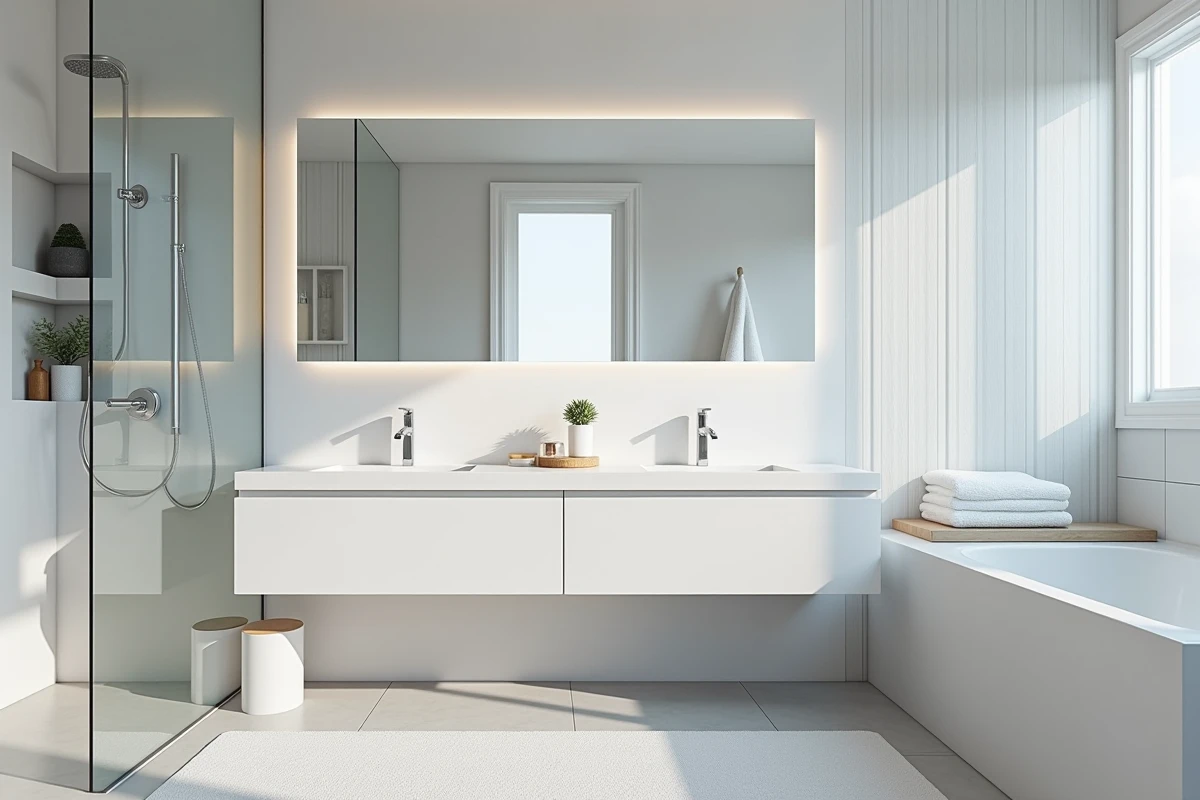
A shallow wall-mounted sink cabinet (around 40 cm) frees up floor space and makes cleaning easier. Prefer a model with drawers rather than hinged doors: drawers make better use of the interior volume and open without obstructing the passage.
For the mirror, a model with integrated storage (a medicine cabinet built into the wall) is a better replacement for a storage column that would take up floor space. This trick saves useful surface area without sacrificing storage for everyday products.
Visual separation between the bedroom and the bathroom
A workshop-style glass partition or a mid-height glass wall allows natural light to pass through while marking a clear boundary between the two areas. The glass partition protects privacy without blocking light, which avoids the “dark corridor” effect often found in small master suites.
A less expensive alternative: a masonry wall about 1.20 m high topped with fixed glazing. The wall can serve as a headboard on the bedroom side and as a support for the plumbing fixtures on the bathroom side.
In a space of fifteen square meters, every technical choice has a cascading effect on the rest of the layout. The most reliable method remains to draw the plan to scale before any purchase, starting with placing the shower and sink, then the bed, and then the circulation. If the passage between two elements drops below 60 cm, the layout needs to be revised. A realistic plan is better than a Pinterest moodboard.